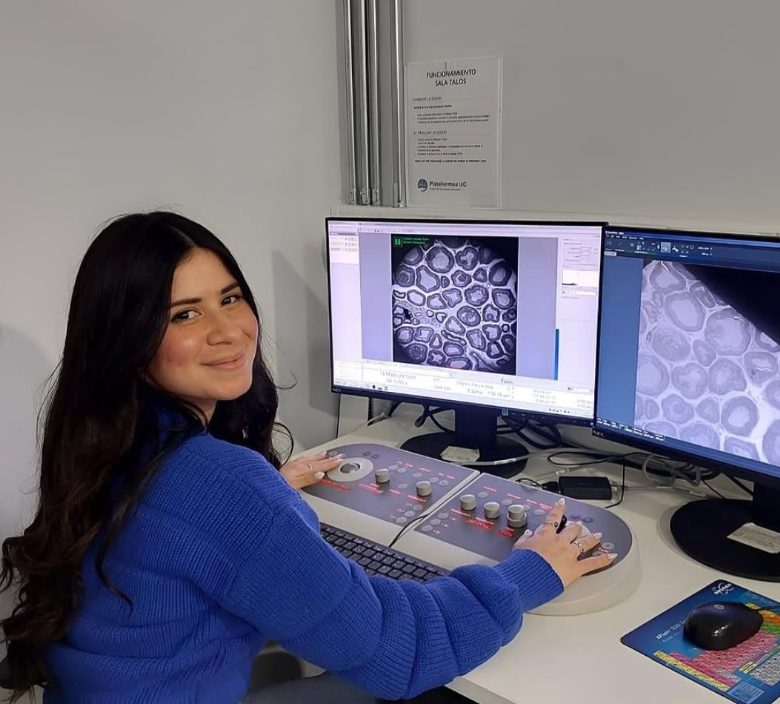
In Texas, Dr. Zulmary Manjarrez is simultaneously leading four research projects focused on pain, the immune system, and neurodegenerative diseases. Her work is opening up a groundbreaking possibility: detecting Parkinson’s disease up to ten years before the first motor symptoms appear.
Before becoming a postdoctoral researcher at the University of Texas, Zulmary Manjarrez was a bioanalysis student at the Central University of Venezuela. During a stay in the Amazon region, something changed. Working with isolated communities far from laboratories, she realized what truly motivated her: connecting with patients.
Back in Caracas, she joined the Institute of Tropical Medicine, where she worked alongside Venezuelan pioneers in immunoparasitology. She later pursued a PhD in Physiology at the Pontifical Catholic University of Chile through a collaboration between two seemingly opposite laboratories: Margarita Calvo’s pain research lab and Rodrigo Pacheco’s renowned neuroimmunology group. It was precisely from this creative tension that her most significant discovery emerged.
When Pain Comes Before Tremors
The World Health Organization estimates that by 2030, at least 12 million people worldwide will be living with Parkinson’s disease. Yet clinical diagnosis still relies primarily on motor symptoms—tremors, rigidity, and bradykinesia—which appear only in the later stages of the disease. Definitive confirmation can currently be achieved only after death through examination of brain tissue.
“The diagnosis can only be confirmed post-mortem. It is literally forensic medicine.”
What Zulmary Manjarrez’s research suggests could fundamentally change this reality. By studying interactions between the gut microbiome and the immune system in mouse models of Parkinson’s disease, her team observed that alpha-synuclein deposits—the hallmark protein associated with Parkinson’s—first appear in the skin long before accumulating in the brain.
These deposits coincide with the onset of neuropathic pain symptoms and are accompanied by progressive denervation of the epidermis: the small nerve fibers normally present in the upper layers of the skin gradually disappear. This phenomenon has already been documented in patients suffering from small-fiber neuropathy.
“It is not new to know that neuropathic pain precedes motor symptoms—that has already been reported in patients. What was new for us was understanding how the microbiome and the immune system interact very early in the disease.”
A Skin Biopsy to Detect the Disease Ten Years Earlier
The therapeutic avenue emerging from this work is both simple and ambitious: using skin biopsies to detect specific alpha-synuclein epitopes as early biomarkers of Parkinson’s disease—potentially up to ten years before the onset of motor symptoms.
“Skin biopsies are incredibly simple to perform. Recovery is easy, and it is a real possibility.”
Among the team’s notable findings is the identification of a nitrosylated form of alpha-synuclein—an epitope not previously reported in association with the disease—which significantly improves the specificity of a potential diagnostic test.
Endometriosis, Sickle Cell Disease, Parkinson’s: Four Projects at Once
Since arriving in Texas and joining the laboratory of Caitlin Sadler and Theodore Price, Zulmary Manjarrez has been pursuing several research fronts simultaneously.
Her primary project focuses on endometriosis, a condition affecting millions of women whose neurological aspects remain poorly understood.
“As a woman, I was very surprised by how little we know about endometriosis.”
Her research aims to map the neurons that innervate the endometrium from the spinal cord—a fundamental question for which scientific literature currently offers only two or three answers, all derived from cadaver studies.
To achieve this, she employs cutting-edge technologies such as spatial transcriptomics and light-sheet imaging, enabling complete three-dimensional reconstruction of organs.
At the same time, she is studying sickle cell disease, a genetic disorder in which deformed red blood cells cause severe and widespread pain. She has also resumed her work on epidermolysis bullosa, research she began during her doctoral studies in Chile.
A fourth project, conducted in collaboration with the TED Prize laboratory, brings her back to Parkinson’s disease—this time using patient samples.
The Secret to Balance: 5 A.M. Yoga and Meticulous Planning
Four projects, constant deadlines, and a manuscript currently being written with a student in Santiago—how does she manage it all?
Zulmary Manjarrez smiles. Since childhood, she has thrived on structured schedules. She wakes up at 5 a.m. every morning, practices yoga—a habit she has maintained for ten years—meditates, and then starts her day.
“This first activity of the day leaves me ready for whatever comes next.”
A discipline that clearly pays off. From Venezuela to Chile, from Germany to Texas, her journey reflects that of a scientist who has never lost sight of her original purpose: understanding pain in order to better care for those who live with it.