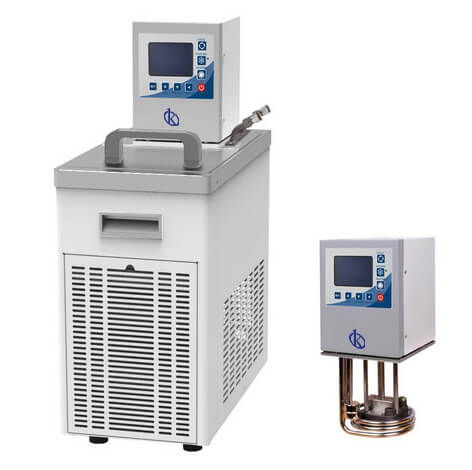
Understanding the Operating Principle of the YR04986 Circulating Bathroom Cooling and Heating Unit
The YR04986 Circulating Bathroom Cooling and Heating Unit is a state-of-the-art piece of laboratory equipment designed to maintain precise temperature control within a range of -40 °C to 100 °C. Understanding its operating principles is crucial for users to maximize its efficiency and ensure reliable performance across various applications, including electronic component testing, chemical synthesis, and life sciences experiments.
Principle of Operation
The YR04986 employs a closed-loop system that utilizes a liquid medium to transfer heat away from or towards the components being tested. The primary scientific principle at work here is thermodynamics, specifically heat transfer through conduction and convection. The unit's advanced PID (Proportional-Integral-Derivative) temperature control system monitors and adjusts the temperature to maintain a stable environment, ensuring that fluctuations are minimized.
Underpinning this system is the concept of thermal equilibrium. When a heated or cooled liquid circulates, it absorbs or dissipates heat, allowing the unit to maintain the desired temperature for extended periods. This capability is essential for experiments requiring consistent thermal conditions.
Technical Specifications of the YR04986
| Model | Temperature (°C) | Stability (°C) | Flow Rate (L/min) | Lift (m) | Capacity (L) | Opening Size (mm) | Depth (mm) | Product Size (WxDxH) |
|---|---|---|---|---|---|---|---|---|
| YR04986 | -5 to 100 | ±0.05 | 14 | 12 | 10 | 160 x 140 | 180 | 450 x 360 x 820 |
Design Choices and Their Justifications
The YR04986's design reflects significant considerations for performance and safety. The use of high-efficiency compressor cooling minimizes energy consumption while maintaining low noise levels, making it suitable for laboratory environments where concentration is crucial. The absence of fluorinated refrigerants is a further nod to environmental concerns, aligning with global sustainability efforts.
Moreover, the stainless steel 304 tank ensures chemical compatibility and durability, allowing the unit to be used in various applications without risk of corrosion. The open design of the tank supports versatility, enabling the YR04986 to be utilized seamlessly for tank experiments as well.
Applications Across Various Fields
The YR04986 is adaptable for a multitude of uses across several sectors. In clinical laboratories, it can be employed for temperature-sensitive diagnostics. In industrial settings, it is essential for quality control processes where temperature regulation is vital. For chemical synthesis, maintaining specific temperatures is critical for reaction kinetics, making this unit invaluable.
Educational institutions benefit from its use in teaching laboratories, providing students with hands-on experience in thermal management principles. The wide temperature range and precise control make it a versatile tool for a variety of experiments.
Common Usage Scenarios and Best Practices
When using the YR04986, several best practices ensure optimal performance. Firstly, calibrating the unit upon installation is essential for accuracy. Regular maintenance checks, including inspections of the cooling system and flow rate, help detect potential issues early.
Furthermore, understanding the specific requirements of the applications can aid in configuring the system properly. For instance, in chemical experiments, one must ensure the liquid medium used is compatible with the substances involved to prevent unwanted reactions and maintain system integrity.
Potential Troubleshooting Scenarios
Users may encounter various issues when operating the YR04986, such as inconsistent temperature readings or alarm triggers. Below is a table outlining some common symptoms, their probable causes, and potential solutions:
| Symptom | Probable Cause | Solution |
|---|---|---|
| Unit does not power on | Power supply issue | Check power connections and circuit breaker |
| Inconsistent temperature readings | Faulty temperature sensor | Calibrate or replace the sensor |
| High noise levels | Worn compressor components | Inspect and replace faulty parts |
| Flow rate below specification | Clogged pump filter | Clean or replace the filter |
Frequently Asked Questions
What temperature range can the YR04986 Circulating Bathroom Cooling and Heating Unit achieve?
The YR04986 can operate within a temperature range of -5 °C to 100 °C, providing versatility for various applications.
How does the PID control system work in the YR04986?
The PID control system continuously monitors the temperature and makes real-time adjustments to maintain the set point, ensuring stability and precision.
What materials are used in the construction of the YR04986?
The YR04986 is constructed with high-quality stainless steel 304, which ensures durability and resistance to chemical corrosion.
Can the YR04986 be used for chemical synthesis?
Yes, the YR04986 is ideal for chemical synthesis due to its ability to maintain specific temperatures crucial for reaction kinetics.
What maintenance is required for the YR04986?
Regular maintenance includes checking the cooling system, cleaning filters, and verifying the calibration of temperature sensors to ensure optimal performance.
Is the YR04986 suitable for educational use?
Absolutely, the YR04986 can be utilized in educational settings to provide practical experience in thermal management and laboratory techniques.
How does the YR04986 contribute to sustainability?
The YR04986 uses high-efficiency cooling mechanisms and avoids the use of fluorinated refrigerants, aligning with sustainable practices.
If you are looking for a fusion of innovation and quality, you have come to the right place. At Kalstein, we offer you the luxury of exploring our exclusive catalog of laboratory equipment. We manufacture every device to the highest standards of excellence. Our intuitive and seamless online purchasing channels are designed for your convenience, securing the most competitive prices. Hesitate no longer — we bring science to life, it is time to become part of our community.