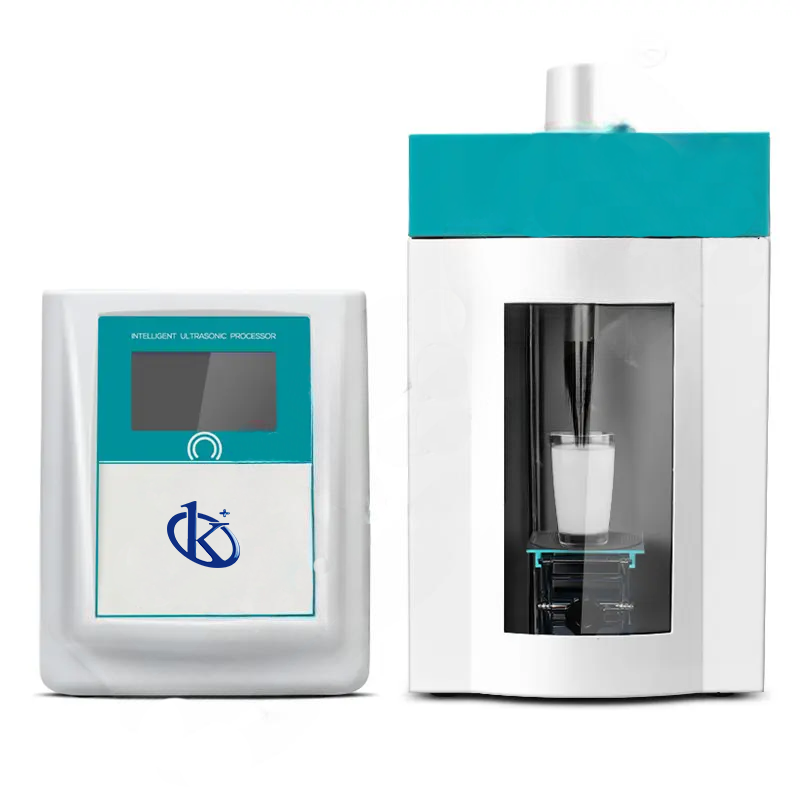
Comparative Analysis of Ultrasonic Homogenizers: Exploring Benefits and Alternatives
Ultrasonic homogenizers are essential tools in laboratories, facilitating the efficient mixing, homogenization, and dispersal of samples. This article delves into the comparative benefits of ultrasonic homogenizers compared to alternative technologies, aimed at laboratory professionals looking for the best solutions for their specific applications.
Understanding Ultrasonic Homogenizers and Their Importance
Ultrasonic homogenizers utilize high-frequency sound waves to agitate and mix materials at the microscopic level. By creating cavitation bubbles in liquids, these devices enhance particle size reduction and uniform dispersion, which is crucial for various applications, including pharmaceuticals, food processing, and material science. This section outlines the principles of ultrasonic homogenization and its significance in modern laboratories.
Comparison of Available Models
| Model | Power (W) | Mixing Capacity (ml) | Price (USD) |
|---|---|---|---|
| YR05015 | 150 | 150 | 756.00 |
| YR05016 | 250 | 300 | 882.00 |
| YR05017 | 650 | 500 | 1050.00 |
| YR05018 | 900 | 600 | 1281.00 |
| YR05019 | 1200 | 1000 | 1785.00 |
| YR05020 | 1800 | 1200 | 2058.00 |
Comparative Advantages of Ultrasonic Homogenizers
When comparing ultrasonic homogenizers to alternative mixing technologies, several advantages emerge. These devices are typically more efficient in breaking down particles and achieving uniform mixtures. The precise control over power settings allows users to optimize the homogenization process for different sample types, leading to better quality outcomes in research and production.
Technical Specifications and Decision Criteria
Each model of ultrasonic homogenizers provides distinct technical specifications that influence their suitability for various applications. Factors such as power ratings, mixing capacity, and features such as PID control and temperature monitoring play a critical role in decision-making. For instance, the YR05019 model provides a robust power output of 1200W, making it ideal for larger sample sizes.
Common Mistakes and How to Avoid Them
Laboratory professionals often encounter pitfalls when selecting and operating ultrasonic homogenizers. Common mistakes include inadequate power settings leading to inefficient homogenization and failure to monitor temperature, which can affect sample integrity. By understanding the specifications of each model, such as the protective features of the YR05015, users can mitigate these risks effectively.
Understanding Alternative Technologies
While ultrasonic homogenizers are powerful tools, it is essential to understand how they compare to alternative technologies like mechanical stirrers or bead mills. Mechanical stirrers may be less effective for achieving fine particle dispersion, whereas bead mills can offer high shear forces but often at the expense of higher operational costs and maintenance. This section evaluates these alternatives in terms of cost, efficiency, and application types.
Real-World Applications of Ultrasonic Homogenizers
In real-world laboratory settings, ultrasonic homogenizers are employed across various industries. For example, in pharmaceuticals, they are critical for the production of emulsions and suspensions. This section provides insight into specific use cases such as vaccine development, where the YR05018 model's capacity for larger volumes is advantageous.
Identifying the Right Model for Your Laboratory Needs
Selecting the right ultrasonic homogenizer requires understanding your specific laboratory needs. Factors such as sample volume, desired homogenization speed, and budget constraints must be considered. This section assists professionals in aligning their requirements with the appropriate model, ensuring they choose a device that meets their operational demands without overspending.
Frequently Asked Questions
What are the benefits of using an ultrasonic homogenizer in laboratory settings?
Ultrasonic homogenizers, such as the YR05017 model, provide enhanced mixing and dispersion capabilities, making them ideal for laboratory applications that require uniformity at a microscopic level. Their precise control allows for tailored processing of different sample types, improving overall quality in research outputs.
How does the energy consumption of ultrasonic homogenizers compare to other mixing technologies?
Ultrasonic homogenizers typically consume less energy compared to traditional mixing technologies like high-speed blenders, especially when used for smaller sample volumes. For instance, the YR05020 model operates efficiently at higher power settings without excessive energy waste, making it a cost-effective choice for labs.
Which ultrasonic homogenizer model is best for large sample volumes?
The YR05020 model is particularly suited for large sample volumes, offering a mixing capacity of up to 1200 ml. Its powerful output of 1800W ensures effective homogenization for applications requiring high throughput, making it a preferred choice in larger laboratories.
What safety features should I look for in an ultrasonic homogenizer?
Safety features such as overheat protection and automatic alarm systems are crucial. Models like the YR05015 provide built-in safeguards against overloads and temperature failures, ensuring safe operation in laboratory environments while protecting sensitive samples.
How can I ensure the longevity of my ultrasonic homogenizer?
To extend the lifespan of an ultrasonic homogenizer, regular maintenance, including cleaning and calibration, is essential. Following the manufacturer’s guidelines, particularly for models such as YR05018, can prevent common issues and maintain optimal performance over time.
What is the typical lifespan of an ultrasonic homogenizer in a lab setting?
The lifespan of ultrasonic homogenizers can vary, but with proper care, models like the YR05019 can last several years, with many units providing reliable service for 5-10 years. Regular maintenance and adherence to operational guidelines significantly contribute to longevity.
How does the cost of ultrasonic homogenizers compare to other laboratory mixers?
Ultrasonic homogenizers, while sometimes higher in initial cost than basic mixers, offer greater efficiency and quality in homogenization. Models like YR05016 provide a competitive price point of $882.00 while delivering superior results compared to traditional mixing technologies.
What applications benefit most from ultrasonic homogenizers?
Applications in pharmaceuticals, food processing, and materials research greatly benefit from ultrasonic homogenization. For example, the YR05018 is ideal for emulsions in vaccine production, ensuring consistency and quality across batches, which is crucial in clinical settings.
If you are looking for a fusion of innovation and quality, you have come to the right place. At Kalstein, we offer you the luxury of exploring our exclusive catalog of laboratory equipment. We manufacture every device to the highest standards of excellence. Our intuitive and seamless online purchasing channels are designed for your convenience, securing the most competitive prices. Hesitate no longer — we bring science to life, it is time to become part of our community.